
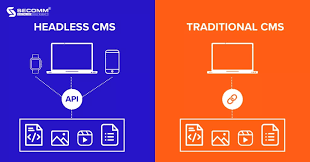
The bigger tech companies grow, the more scaling needs to be a priority; the challenge lies in when it becomes increasingly complicated. The longer companies are in business, the more users they accumulate, the more platforms become available, and the greater the expansive features. All of this compounds pressure onto the backend and content infrastructure. The more effort demanded from monolithic CMS platforms, however, the worse they perform. Instead, a headless CMS is an advanced API-first approach built for sustained growth and performance, manifesting faster, leaner and more flexibly for tech products that want to scale without falling apart.
H2: Decoupling for Added Flexibility and Expansion
The headless CMS model works by separating content from presentation. How Storyblok is changing CMS can be seen in how modern platforms embrace this decoupled architecture to enable faster development and greater flexibility. Frontend teams and backend teams can operate independently. Thus, in a decoupled architecture, as your technology product expands, you’re not fettered to the limitations of a consistent template or means of delivery. Instead, once appropriately modeled, content can be delivered via APIs to web apps, mobile apps, IoT devices, and more. New platforms can be launched, existing experiences can be modified, or alternative GUIs may be explored without changing the CMS in its entirety, which is critical for growth in a fast-paced atmosphere.
H2: Multimodal Teams Scale Without Backlogs and Dependencies
As a product expands, the teams behind it will, as well. Engineering, marketing, product, and design must all operate simultaneously; a headless CMS allows for this expansion by permitting cross-functional teams to exist within their respective workflows. Developers can work on API integration and UI components while content teams focus on creating the latest and greatest without unnecessary pushback and bottlenecks. Since a headless CMS does not offer a template on the frontend, all team members can use what they have to without relying on any other department to get their pieces done which reduces dependencies in the development process and fosters faster iterations for release.
H2: Accelerating Delivery Through API-Centric Development For Performance and Scalability
One of the biggest strengths of headless CMS platforms exists in their API-first construction. By offering up data through RESTful or GraphQL APIs, even the most legacy of headless content management systems create the opportunity for content to be served up dynamically wherever it is sought through an API call. When developing highly comprehensive products for worldwide appeal, this means offering information through distributed CDNs for lower latency and higher traffic support. Whether it’s sending data to a single page app or pushing synchronization of dynamic content to a native mobile app, the API-first construction supports speed, performance and scalable solutions to all digital endpoints.
H2: Facilitating Modular Design Systems for Differentiation Yet Consistent Reuse
When expanding, it’s easy to get complicated but the headless CMS helps compartmentalize that complication through modular content modeling by assembling all content as reusable blocks or components with clear relevance to front-end design systems. Tech teams can maintain consistent designs across differentiating experiences by not having to redundantly build content. For example, a product description can be used as a module across a website, an application, and a help center with little deviation. Therefore, not only can scaled UX design be supported through consistency and uniqueness of purpose across platforms, but also time is saved in development that would otherwise need to be spent in undertaking redundant tasks.
H2: The Benefits of a Headless CMS for Growth Enterprise Localization and Global Launches
When technology companies enter new markets, localization is often required. Headless CMS systems are the best for tackling such a phenomenon. Content models are set up in such a way that language adaptations, regional sensibilities, and compliance needs are easy to note and track. APIs allow content to be sent to specific front ends based on geography or requests, and a relative structure makes it easy for global launches to play nice with one another and be consistent across language fidelity yet at scale without the redundancy of time or process.
H2: The Ease of Integration with Other Microservices and Tools
Scalable technology products rely on a larger ecosystem of tools from CRMs to analytics software to payment processing to translation engines and many more. A headless CMS more easily blends into a microservices environment as one connected service, not a single, all-in-one tool trying to provide everything. Middleware can use CMS information to add additional data, webhooks can trigger actions to bring the information outside of the CMS domain. This is important because as technology becomes more complex, it would be unfortunate for a CMS to become a silo; rather, it should be integrated into as many processes as possible for more ubiquitous operation.
H2: The Importance of Governance and Versioning with Change
As teams create various content within regions, platforms, and product lines, governance becomes increasingly critical. A headless CMS helps maintain this because it’s clear who has what permissions to publish whatever and what roles exist in the content development process. Versioning exists relative to oversights and appropriate team inputs; thus a headless CMS supports the governance effort that’s required as teams scale rapidly and by keeping compliance and quality controls up to speed without additional manual processes. This meets the expectations of enterprise-level technology systems.
H2: Future-Proof Your Product Infrastructure
Technology changes rapidly. Scalability doesn’t merely refer to growing but also adapting. A headless CMS establishes a future-proofed content infrastructure that can accommodate new frontend frameworks, different channels, or changing user expectations. Since content is separated and delivered through APIs, teams can rebuild frontends or create new frontends from scratch without worrying about content migration or halted production efforts. From transitioning a web experience to a native app to adding AR features to looking at voice-activated portals and more, the CMS remains constant and ready to support whatever the ambitious product team desires.
H2: Accelerate Time-to-Market in Rapidly Changing Tech Markets
Rapidly changing tech markets require any product to act fast. Headless CMS systems support reduced time-to-market by driving fast-paced processes. With purposefully designed content structures and accessible integrations, teams can set up new pages, sites, campaigns and features in hours instead of days or weeks. For early-stage products, this is critical for maintaining team momentum and for growth-stage products eager to respond to user feedback, investor requirements or competitive pressures nobody wants to be faced with the delay of adding new features because systems won’t keep pace.
H2: Support Rapid Experimentation/A/B Testing at Scale
The larger tech solutions develop, the more they need to implement A/B testing and experimentation at scale, but anyone who has worked on a front-end solution knows how hard it is to accommodate last-minute edits while simultaneously working on UX/UI development. The headless CMS makes this process seamless as developers can provide segmented users with different iterations of content without having to hardcode adjustments or create repetitive structures. They can react to user inputs almost instantaneously and push new headlines, images and CTAs through the CMS while assessing performance across applications.
H2: Manage Content Across Multi-Product Ecosystems
Few successful tech companies remain successful with only one product growing. Organizations find themselves raising additional venture capital to dive into new applications even if that means creating intra-organization solutions that rely on uniformity across products but nuance between offerings. A headless CMS makes this far simpler to manage as even if unique frontends across products emerge, centralized content structures make it easy to share, amend or recycle content across applications. Whether onboarding experiences, help center resources or disclaimers and policies, organizations can source one single source of truth for consistent solutions across offerings with enough flexibility for nuance of where and how content gets implemented.
H2: Elevating Developer Experience Through Clean Architecture
Scalability is not just in systems but in people, too. A headless CMS facilitates a better developer experience thanks to clean architecture, modularity, and true development autonomy. Development teams are not forced to work within the rigid templating systems of legacy and the monolithic backends of the past. Instead, they work within clearly defined boundaries where content is a service instead of a requirement buried within application logic. Since content does not have to be dependent on what’s going on in the front and back, there’s less ambiguity and easier reasoning as everything scales.
For instance, frontend teams can think this way. They can build their UX/UI within frameworks like React, Vue, or Svelte and only API-call what content they need at runtime. They’re not beholden to legacy rendering engines or logic specific to a CMS’ methodologies. They’re free to leverage performance improvements, component libraries, and design systems that comply with modern standards. Ultimately, this leads to cleaner codebases and architecturally sounder frontends over time.
The same goes for backend developers since they can focus on business logic, integrations, authentication barriers, and infrastructure without stepping on editorial access toes or vice versa. Content teams manage the CMS; backend teams manage services and API interaction. This means separate concerns aren’t able to accidentally cross over and create unnecessary dependencies that are the basis for technical debt.
The same can be said for onboarding new team members and growing without needing to document an arcane knowledge base. Knowing who is responsible for what is half the battle when new developers enter the fold. They don’t need to know how to render with a proprietary CMS beforehand. They need to know how to integrate with a standard API pattern and modular components. Over time, this saves ramp-up time and ensures that knowledge silos do not develop around idiosyncrasies of proprietary rendering.
Ultimately, however, a headless CMS allows developers to think freely without continual concern for CMS integration and implications. Should teams want to test a new framework, alternative rendering approach, or infrastructure improvement down the line while making decisions about where to store their content, they’re welcome to do so without having their hands tied. Headless fosters an environment of creative problem-solving through constant improvement and when integration is not an issue but driven by a philosophy of sustainable action for continuous change, then scalability is not merely a property of architecture but one of the team’s workflow in which they can move quickly, confidently, and sustainably as long as it exists.
H2: Conclusion: Scaling Smarter with a Headless CMS
For fast-growing technology products, scale is an absolute necessity not a luxury. Scale needs to apply to every single layer of the digital stack. While user bases, features, and platforms expand, delivering the same level of performant, rich content across the board becomes more complicated and yet, increasingly vital. For example, a traditional, monolithic CMS can become a burden during this growth stage, preventing innovation, slowing down releases, and adding to additional maintenance. A headless CMS, however, is more appropriately positioned to support constant scale and ever-changing product requirements.
First, a headless CMS offers a scalable content strategy that keeps the company ahead of the game, not against it. Teams can rapidly deploy with an API-first approach so that a decoupled CMS allows for the front-facing technologies to be formulated while the backend never misses a beat. Companies can scale culturally across countries and geographies with ease but also, within various use cases and contexts. Whether new features are being deployed on multiple continents simultaneously, a companion mobile app is released in tandem, or an onboarding flow scales to individualized in-app experiences, a headless CMS empowers teams to move faster without worrying about structure and consistency.
Second, content no longer has to sit at the backend for posterity’s sake. A headless CMS revolutionizes the purpose of content as it gives dynamic value to a once stagnant asset. Organizations can manage content in one place for similar presentations no matter the medium or sub-audience allowing for fewer frustrations through inconsistent deliveries. Teams can work concurrently, leverage automation and third-party services with greater ease than before, and the CMS may act as the nexus between everything within an even larger composable architecture that champions performance and growth throughout all digital product lifetimes.
In an ever-growing world where change is often constant and digital experiences must evolve in line with user expectations, a headless CMS is more than an option it champions scale. Businesses can embrace change without taking steps back; they can operate on their feet and trust that their foundation will never let them down through challenged experiences.

